


Checking the clock and asking “how long until 1:30” is one of those small questions that comes up all day. Maybe you have a lunch meeting, a school pickup, a call with a client in another time zone, or a late-night alarm.
The answer depends on two things: what time it is right now, and whether you mean 1:30 AM or 1:30 PM. This guide gives you the quick answer, charts you can scan in seconds, and a method that works for any starting time.
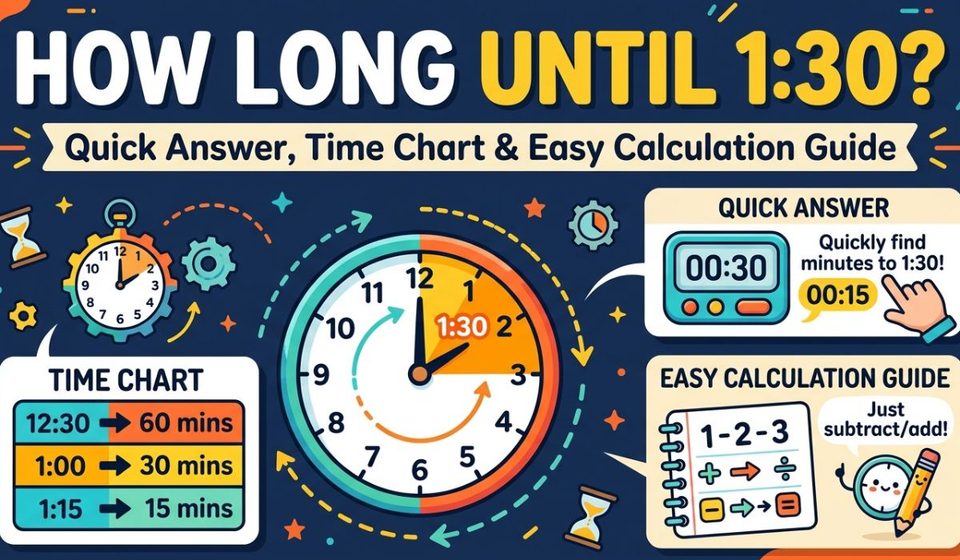
Quick Answer: How Long Until 1:30?
The wait until 1:30 is the difference between your current time and 1:30. If it is 12:30 right now, it is exactly 1 hour until 1:30. If it is 1:00, it is 30 minutes. If it is 1:25, it is 5 minutes.
Here is the fastest way to remember it: from any time on the hour, the gap to 1:30 is simple. From 12:00 it is 1 hour 30 minutes, and from 11:00 it is 2 hours 30 minutes. Every hour earlier adds another full hour to the wait.
Because I cannot see your clock, use the tables below. Find your current time in the left column and read the wait next to it.
How Long Until 1:30 PM From Common Times
Most people searching this phrase mean 1:30 in the afternoon. That is the slot for lunch breaks, post-lunch meetings, and school schedules. The table below shows the wait from the most common morning and early afternoon times.
| Current Time | Time Left Until 1:30 PM | Total Minutes |
| 8:00 AM | 5 hours 30 minutes | 330 |
| 9:00 AM | 4 hours 30 minutes | 270 |
| 10:00 AM | 3 hours 30 minutes | 210 |
| 11:00 AM | 2 hours 30 minutes | 150 |
| 11:30 AM | 2 hours | 120 |
| 12:00 PM | 1 hour 30 minutes | 90 |
| 12:30 PM | 1 hour | 60 |
| 12:45 PM | 45 minutes | 45 |
| 1:00 PM | 30 minutes | 30 |
| 1:15 PM | 15 minutes | 15 |
| 1:25 PM | 5 minutes | 5 |
If your current time is between these rows, add or subtract the minutes. At 12:50 PM, for example, you are 40 minutes away, which sits between the 12:45 and 1:00 rows.
How Long Until 1:30 AM From Common Times
The AM version matters for night owls, shift workers, travelers, and anyone setting a very early alarm. Because 1:30 AM falls after midnight, the wait crosses into the next calendar day for most evening start times.
| Current Time | Time Left Until 1:30 AM | Total Minutes |
| 6:00 PM | 7 hours 30 minutes | 450 |
| 8:00 PM | 5 hours 30 minutes | 330 |
| 9:00 PM | 4 hours 30 minutes | 270 |
| 10:00 PM | 3 hours 30 minutes | 210 |
| 11:00 PM | 2 hours 30 minutes | 150 |
| 11:30 PM | 2 hours | 120 |
| 12:00 AM | 1 hour 30 minutes | 90 |
| 12:30 AM | 1 hour | 60 |
| 1:00 AM | 30 minutes | 30 |
Notice the pattern. The numbers match the PM table because the hour gaps are the same. Only the label changes. That is why the method below works for both.
How to Calculate How Long Until 1:30
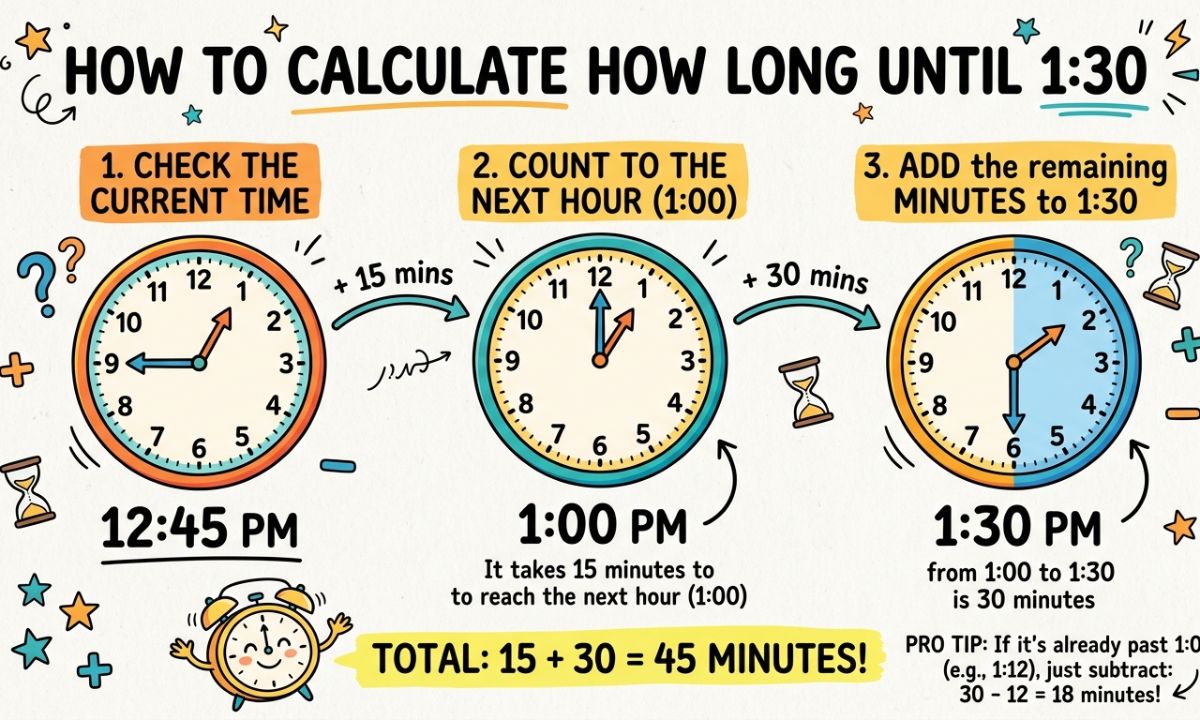
You do not need a calculator. Four short steps cover every case, and once you have done it a few times, you will do it in your head.
Step 1: Decide Between AM and PM
Start by confirming which 1:30 you mean. If it is morning now and you want the afternoon time, you mean 1:30 PM. If it is evening now and you are heading toward the small hours, you mean 1:30 AM. Getting this wrong is the most common reason for a wrong answer.
Step 2: Convert Both Times to 24-Hour Format
The 24-hour clock removes the AM and PM confusion. Times after noon get 12 added to the hour. So 1:30 PM becomes 13:30, and 10:45 AM stays 10:45. For 1:30 AM, the 24-hour form is 01:30.
Step 3: Subtract the Current Time From 1:30
Subtract hours from hours and minutes from minutes. If it is 10:00 AM and your target is 13:30, then 13 minus 10 is 3 hours, and 30 minus 0 is 30 minutes. The answer is 3 hours 30 minutes.
Step 4: Borrow an Hour When the Minutes Do Not Fit
Sometimes the current minutes are higher than 30, which makes the subtraction go negative. In that case, borrow one hour and add 60 minutes. Let’s say it is 10:45 AM and the target is 13:30. Rewrite 13:30 as 12 hours and 90 minutes, then subtract 10 hours and 45 minutes. You get 2 hours 45 minutes.
You can always check your work by adding the answer back. Start at 10:45, add 2 hours 45 minutes, and you land on 13:30.
Worked Examples With Real Scenarios
Examples make the method stick. Here are four situations that match what people actually search for.
Example 1: Lunch Meeting at 1:30 PM
You are at your desk at 11:50 AM. To reach 1:30 PM, count to noon first, which is 10 minutes. Then add 1 hour 30 minutes. The total wait is 1 hour 40 minutes.
Example 2: Flight Boarding at 1:30 AM
It is 4:50 PM and boarding starts at 1:30 AM. In 24-hour terms, that is 16:50 to 25:30, where 25:30 means 1:30 the next morning. The difference is 8 hours 40 minutes.
Example 3: Appointment Tomorrow at 1:30 PM
It is 3:00 PM today and your appointment is at 1:30 PM tomorrow. From 3:00 PM to midnight is 9 hours, and midnight to 1:30 PM is 13 hours 30 minutes. Together, that is 22 hours 30 minutes.
Example 4: Quick Break Timer
You start a 20-minute break at 1:05 PM and want to be back by 1:30 PM. The clock shows 25 minutes until 1:30, so you have a 5-minute cushion. Small gaps like this are where the minute shortcut below helps most.
The Minute Shortcut for Nearby Times
When the current time is close to 1:30, skip the full method. Use the minutes on the clock. If the minutes are under 30 and the hour is 1, subtract them from 30. At 1:10, you have 20 minutes left. If the hour is 12, add 60 first, which means you subtract the minutes from 90.
| Current Time | Quick Math | Wait |
| 1:05 | 30 – 5 | 25 minutes |
| 1:10 | 30 – 10 | 20 minutes |
| 1:20 | 30 – 20 | 10 minutes |
| 12:40 | 90 – 40 | 50 minutes |
| 12:50 | 90 – 50 | 40 minutes |
| 12:55 | 90 – 55 | 35 minutes |
Converting the Wait Into Hours, Minutes and Seconds
Sometimes the wait needs to be in a different unit, such as a countdown timer, a spreadsheet, or a study schedule. These conversions come up often when you work with 1 hour 30 minutes, which is the wait from noon.
| Wait Time | In Minutes | In Seconds | In Decimal Hours |
| 30 minutes | 30 | 1,800 | 0.5 |
| 45 minutes | 45 | 2,700 | 0.75 |
| 1 hour | 60 | 3,600 | 1.0 |
| 1 hour 30 minutes | 90 | 5,400 | 1.5 |
| 2 hours 30 minutes | 150 | 9,000 | 2.5 |
| 3 hours 30 minutes | 210 | 12,600 | 3.5 |
Decimal hours help when you track billable time or build a schedule in a spreadsheet. Since 30 minutes is half an hour, any wait that ends at 1:30 from an on-the-hour start will finish in .5.
Time Zone Tip: 1:30 in Another Location
A lot of searches for this phrase come from remote workers and families split across countries. If someone says “let’s talk at 1:30,” always ask which time zone they mean. A call at 1:30 PM in one city can be late evening or the middle of the night somewhere else.
The cleanest habit is to write the time with the zone, such as 1:30 PM Eastern or 13:30 UTC. Then each person converts from that fixed point. Once you know the local 1:30, the calculation in this guide gives you the wait.
Common Mistakes When Calculating How Long Until 1:30
Most errors are small and easy to prevent. Here are the ones that trip people up most often.
- Mixing up AM and PM. Counting toward 1:30 PM when you meant 1:30 AM can leave you 12 hours off. Always confirm which half of the day you need.
- Forgetting that 12 comes before 1. Noon and midnight both show as 12:00, and the next hour is 1:00. People often treat 12 as 0 and drop an hour from the answer.
- Subtracting minutes in the wrong direction. If it is 10:45 and you subtract 45 from 30 without borrowing, you get a negative number. Borrow an hour and add 60 minutes.
- Ignoring the date change. Crossing midnight means the target sits on the next day. Add 24 hours to the target or count to midnight first.
- Overlooking daylight saving time. On the weekend clocks change, the real wait can be an hour longer or shorter. Check your local rule before you trust a simple subtraction.
Why People Search for “How Long Until 1:30”
This keyword feels simple, but the reasons behind it are quite varied. Understanding them shows why quick, accurate answers matter.
- Lunch and work breaks. Many offices run a 12:30 to 1:30 lunch window, so people check how much of it is left.
- School and class schedules. Early dismissal, afternoon classes, and exam sessions often start or end at 1:30.
- Appointments and meetings. Doctor visits, interviews, and video calls are commonly booked at half-past times.
- Late-night plans. Shift changes, flights, bus departures, and alarms can fall at 1:30 AM.
- Cooking and event timing. Someone planning a meal or a party works backward from a 1:30 serving time.
- Sleep planning. People who go to bed late want to know how many hours remain before a very early wake-up.
In most cases, the person wants a number they can trust right away, not a long explanation. That is why the chart is the best starting point.
Related Calculations and Similar Countdowns
If you are tracking 1:30, you may also care about nearby times. The table below shows the wait from 12:00 PM to a few closely related targets, so you can compare them at a glance.
| Target Time | Wait From 12:00 PM |
| 1:00 PM | 1 hour |
| 1:15 PM | 1 hour 15 minutes |
| 1:30 PM | 1 hour 30 minutes |
| 1:45 PM | 1 hour 45 minutes |
| 2:00 PM | 2 hours |
| 2:30 PM | 2 hours 30 minutes |
The same method works for any of them. Convert to 24-hour time, subtract, and borrow an hour if needed. Once you understand the pattern for 1:30, countdowns to 2:00, 2:30, 3:30, and 12:30 take the same few seconds.
You can also flip the question around. Instead of asking how long until 1:30, ask what time it will be after a set wait. Add the wait to the current time. From 11:15 AM, 2 hours 15 minutes later is 1:30 PM.
Conclusion
Working out how long until 1:30 comes down to one simple move: subtract your current time from 1:30, using the 24-hour clock to avoid AM and PM mistakes. From noon, you wait 1 hour 30 minutes. From 1:00, you wait 30 minutes.
Use the charts above for a fast answer, the step-by-step method for any start time, and the minute shortcut when you are close. Check AM versus PM, watch for midnight, and your countdown will be right every time.
Frequently Asked Questions
How long until 1:30 if it is 12:00 PM right now?
You have 1 hour 30 minutes, which equals 90 minutes. That is the most common starting point for the 1:30 PM countdown.
How long until 1:30 PM from 10:00 AM?
The wait is 3 hours 30 minutes, or 210 minutes. Add 30 minutes for each half hour you move earlier.
How many minutes are in the wait from 12:30 to 1:30?
There are exactly 60 minutes, which is 1 hour. This is one of the cleanest gaps to remember.
How long until 1:30 AM if it is 11:00 PM?
You have 2 hours 30 minutes. The countdown crosses midnight, but the subtraction method handles it with no extra steps.
How do I find the wait when the current time is past 1:30?
If 1:30 has already passed today, count to 1:30 on the next day. For example, from 2:30 PM, the wait to 1:30 PM tomorrow is 23 hours.


[…] glance at the clock, you have something at 2:40, and you want to know how much time is left. That is a simple question, but doing the math in your head gets messy when the hour and […]