


You glance at the clock, then ask yourself a simple question: what time was it 11 hours ago? Maybe you’re tracking a shift, checking when you last took a medicine dose, or trying to figure out whether that email landed before or after midnight.
Here’s the short version. To find the time 11 hours ago, subtract 11 hours from the current time. If the result drops below 12:00 AM, you land on the previous day. And if you want a faster route, there’s a neat shortcut on the 12-hour clock that takes about two seconds. We’ll cover it below, along with charts, examples, and the mistakes that trip people up.
Quick Answer: What Time Was It 11 Hours Ago?
11 hours ago = current time − 11 hours.
That’s the whole formula. A few instant examples:
- If it’s 3:00 PM now, 11 hours ago it was 4:00 AM (same day).
- If it’s 9:00 AM now, 11 hours ago it was 10:00 PM (previous day).
- If it’s 11:00 PM now, 11 hours ago it was 12:00 PM (noon, same day).
The fastest mental shortcut: add 1 hour to the current time on the clock face, then flip AM to PM (or PM to AM). We’ll break down why this works shortly.
Quick Reference Table
| Current Time | Time 11 Hours Ago | Day |
| 12:00 AM (midnight) | 1:00 PM | Previous day |
| 6:00 AM | 7:00 PM | Previous day |
| 11:00 AM | 12:00 AM (midnight) | Same day |
| 12:00 PM (noon) | 1:00 AM | Same day |
| 6:00 PM | 7:00 AM | Same day |
| 11:00 PM | 12:00 PM (noon) | Same day |
Full 24-Hour Chart: What Time Was It 11 Hours Ago?
Bookmark this one. It covers every full hour on the clock, so you can look up your answer without doing any math.
| Current Time (12-hour) | Current Time (24-hour) | 11 Hours Ago (12-hour) | 11 Hours Ago (24-hour) | Day |
| 12:00 AM | 00:00 | 1:00 PM | 13:00 | Yesterday |
| 1:00 AM | 01:00 | 2:00 PM | 14:00 | Yesterday |
| 2:00 AM | 02:00 | 3:00 PM | 15:00 | Yesterday |
| 3:00 AM | 03:00 | 4:00 PM | 16:00 | Yesterday |
| 4:00 AM | 04:00 | 5:00 PM | 17:00 | Yesterday |
| 5:00 AM | 05:00 | 6:00 PM | 18:00 | Yesterday |
| 6:00 AM | 06:00 | 7:00 PM | 19:00 | Yesterday |
| 7:00 AM | 07:00 | 8:00 PM | 20:00 | Yesterday |
| 8:00 AM | 08:00 | 9:00 PM | 21:00 | Yesterday |
| 9:00 AM | 09:00 | 10:00 PM | 22:00 | Yesterday |
| 10:00 AM | 10:00 | 11:00 PM | 23:00 | Yesterday |
| 11:00 AM | 11:00 | 12:00 AM | 00:00 | Today |
| 12:00 PM | 12:00 | 1:00 AM | 01:00 | Today |
| 1:00 PM | 13:00 | 2:00 AM | 02:00 | Today |
| 2:00 PM | 14:00 | 3:00 AM | 03:00 | Today |
| 3:00 PM | 15:00 | 4:00 AM | 04:00 | Today |
| 4:00 PM | 16:00 | 5:00 AM | 05:00 | Today |
| 5:00 PM | 17:00 | 6:00 AM | 06:00 | Today |
| 6:00 PM | 18:00 | 7:00 AM | 07:00 | Today |
| 7:00 PM | 19:00 | 8:00 AM | 08:00 | Today |
| 8:00 PM | 20:00 | 9:00 AM | 09:00 | Today |
| 9:00 PM | 21:00 | 10:00 AM | 10:00 | Today |
| 10:00 PM | 22:00 | 11:00 AM | 11:00 | Today |
| 11:00 PM | 23:00 | 12:00 PM | 12:00 | Today |
Notice the pattern? Every row shows the “ago” time exactly one hour later on the clock face, with AM and PM swapped. That’s the trick, and it’s not a coincidence.
How to Calculate What Time Was It 11 Hours Ago
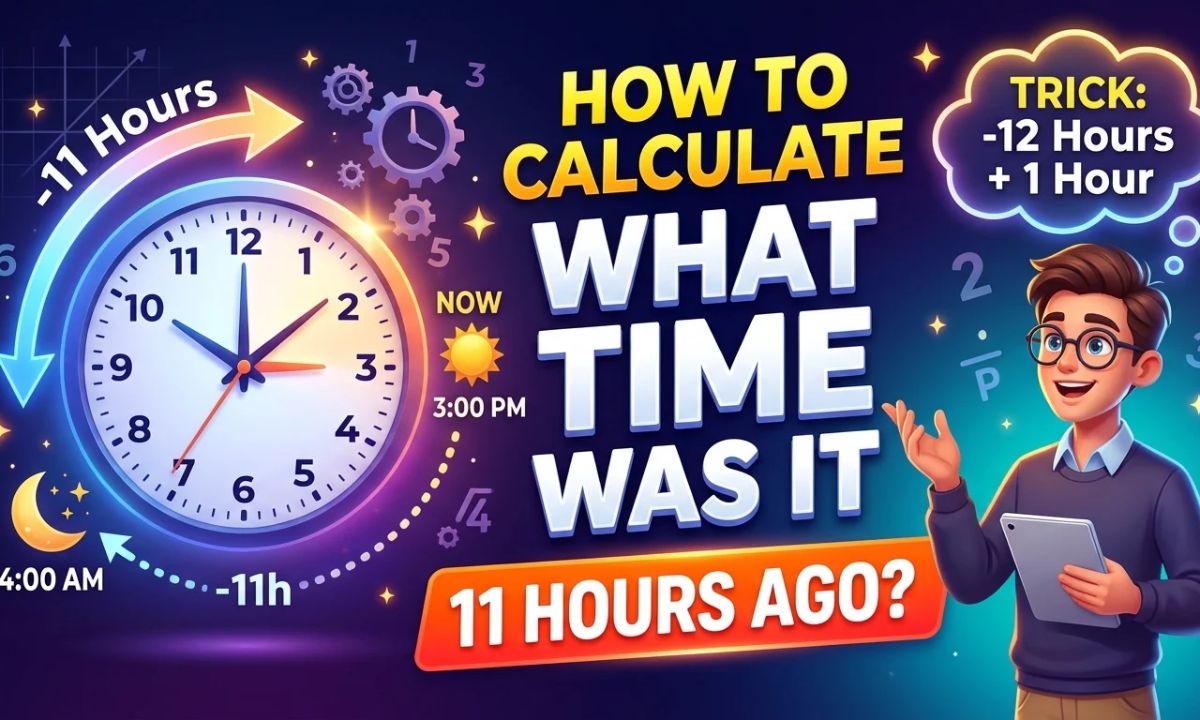
There are three reliable ways to do this. Pick whichever feels natural.
Method 1: Straight Subtraction (24-Hour Clock)
This is the cleanest method, and it works for any time.
- Convert the current time to 24-hour format (3:45 PM becomes 15:45).
- Subtract 11 from the hour. Leave the minutes alone.
- If the result is negative, add 24 and move back one day.
Example: Current time is 15:45. 15 − 11 = 4, so the answer is 04:45 (4:45 AM, same day).
Example with a day change: Current time is 07:20. 7 − 11 = −4. Add 24 and you get 20, so the answer is 20:20 (8:20 PM, previous day).
Method 2: The “Add One, Flip It” Shortcut
Here’s why this works. Twelve hours is exactly half a day, so going back 12 hours just flips AM and PM without changing the number. Going back 11 hours is one hour less than that. So you take the flipped time and add the missing hour.
- Take the current time.
- Add 1 hour.
- Swap AM for PM, or PM for AM.
Example: It’s 5:30 PM. Add 1 hour for 6:30, flip PM to AM. Answer: 6:30 AM.
The one wrinkle is the day. If your flip moves you from AM to PM, you’ve gone back into the previous day. If it moves you from PM to AM, you’re still on the same day.
Method 3: Count Back in Two Chunks
Some people find this easier to picture. Go back 12 hours, then forward 1.
Example: It’s 2:15 PM. Back 12 hours is 2:15 AM. Forward 1 hour is 3:15 AM.
Working With Minutes and Seconds
Minutes don’t change when you subtract whole hours. If it’s 8:47 PM, then 11 hours ago was 9:47 AM. Only the hour moves.
For reference, here are the unit equivalents:
| Unit | 11 Hours Equals |
| Minutes | 660 minutes |
| Seconds | 39,600 seconds |
| Days (decimal) | 0.4583 days |
| Half-days | 0.917 of a half-day (12 hours minus 1 hour) |
Real-World Examples
Numbers on a chart are fine, but let’s see how this plays out in actual situations.
| Scenario | Current Time | 11 Hours Ago | What It Tells You |
| Night shift check | 7:00 AM | 8:00 PM (yesterday) | When your shift started |
| Last meal | 2:30 PM | 3:30 AM | You ate before sunrise |
| Flight tracking | 10:15 PM | 11:15 AM | The flight left in late morning |
| Social media post | 12:05 PM | 1:05 AM | A post that went up overnight |
| Package scan | 4:40 PM | 5:40 AM | Left the warehouse early morning |
| Sleep tracking | 6:00 AM | 7:00 PM (yesterday) | Evening, before you went to bed |
Across Time Zones
Things get a bit messier when you’re coordinating with someone in another city. The rule is simple, though: calculate 11 hours ago in one time zone first, then convert.
Say it’s 9:00 PM UTC right now. Eleven hours ago was 10:00 AM UTC. If you want that moment in Pakistan Standard Time (UTC+5), add 5 hours and you get 3:00 PM PKT. Same moment, different clock.
| Time Zone | Offset | Current Time | 11 Hours Ago |
| UTC | +0 | 9:00 PM | 10:00 AM |
| PKT (Pakistan) | +5 | 2:00 AM (next day) | 3:00 PM |
| IST (India) | +5:30 | 2:30 AM (next day) | 3:30 PM |
| GST (Dubai) | +4 | 1:00 AM (next day) | 2:00 PM |
Always do the subtraction within a single zone. Mixing offsets and subtraction in one step is where errors creep in.
Common Mistakes When Figuring Out 11 Hours Ago
Most wrong answers come from a handful of predictable slips.
Forgetting the Day Changes
If it’s 8:00 AM and you subtract 11, you can’t just write “9:00 PM” and move on. That’s yesterday’s 9:00 PM. When the clock crosses midnight going backward, the date goes back too. This matters a lot if you’re logging events, filing reports, or checking deadlines.
Mixing Up AM and PM
At 12:00 PM (noon) and 12:00 AM (midnight), people often flip the labels wrong. Remember: 12:00 PM is noon, 12:00 AM is midnight. So 11 hours before 11:00 AM is 12:00 AM, which is midnight at the start of the same day.
Subtracting 12 Instead of 11
It’s an easy slip. Subtracting 12 just flips AM/PM. Subtracting 11 flips it and nudges the hour by one. If your answer matches the current time number exactly, you probably used 12.
Ignoring Daylight Saving Time
If a clock change happened in the last 11 hours, the real elapsed time and the clock difference won’t match. In places that observe daylight saving, the night of a clock change contains either 23 or 25 hours. If you’re calculating across that window, check the local rules or use a time zone tool.
Doing Math on Mixed Formats
Don’t subtract 11 from “3:45 PM” as if 3 − 11 gives you something meaningful. Convert to 24-hour time first, or use the add-one-and-flip trick.
Why Do People Search “What Time Was It 11 Hours Ago”?
It looks like an odd question, but the reasons are practical.
- Shift work and sleep tracking. Nurses, security staff, and drivers often need to know when a stretch of work began.
- Medication and meal timing. People check when something happened relative to now, especially for doses spaced out through the day.
- Time zone confusion. An 11-hour gap sits close to the offset between many popular regions, so it comes up when people compare local times across continents.
- Online activity. “Posted 11 hours ago” shows up on social platforms, news sites, and forums. Readers want the actual clock time of that post.
- Logs and timestamps. Developers, analysts, and support teams often need to translate relative times into exact ones.
- Travel and flights. Long-haul journeys regularly last around 11 hours, so travelers ask when they took off or when they should have eaten last.
- Curiosity about the schedule of the day. Some people simply want to know how long it’s been since morning, midnight, or sunrise.
The common thread: a relative time (“11 hours ago”) is hard to use. A clock time is easy.
Related Calculations and Topics
If you’re comfortable with 11 hours ago, these neighbors are easy to handle with the same logic.
| Question | Quick Method |
| What time was it 10 hours ago? | Add 2 hours on the clock face, flip AM/PM |
| What time was it 12 hours ago? | Same number, flip AM/PM |
| What time was it 13 hours ago? | Subtract 1 hour on the clock face, flip AM/PM |
| What time will it be in 11 hours? | Add 11 hours; same as subtracting 13 in reverse |
| How many minutes ago was 11 hours? | 660 minutes |
You might also find these topics useful:
- Converting 12-hour time to 24-hour time
- Calculating time differences between cities
- How daylight saving time shifts your math
- Counting hours between two clock times
- Working out elapsed time across midnight
Once you see that every “hours ago” question is really just a shifted clock, they all become the same problem.
Conclusion
So, what time was it 11 hours ago? Subtract 11 from the current time, and remember the date rolls back if you cross midnight. For a quick mental answer, add one hour to the clock face and flip AM to PM, or PM to AM.
Use the 24-hour chart above when you want a fast lookup, and watch out for the usual slips: skipping the day change, confusing noon and midnight, and subtracting 12 by habit. Do that, and you’ll get the right answer every time.
Frequently Asked Questions
What time was it 11 hours ago from now?
Subtract 11 hours from the current time. For example, if it’s 4:00 PM now, then 11 hours ago it was 5:00 AM on the same day.
Is 11 hours ago yesterday or today?
It depends on the current time. If it’s 11:00 AM or later, 11 hours ago falls on today. Before 11:00 AM, it falls on yesterday.
How do I calculate 11 hours ago without a calculator?
Add 1 hour to the current time and switch AM to PM or PM to AM. At 8:00 PM, that gives you 9:00 AM.
How many minutes and seconds are in 11 hours?
Eleven hours equals 660 minutes, or 39,600 seconds.
What time was it 11 hours ago in a different time zone?
First work out 11 hours ago in your own zone, then convert using the offset. Doing the subtraction in a single time zone avoids most mistakes.


[…] glance at the clock and need a number fast: how many minutes until 9:50 AM today? Maybe it’s a meeting, a school bell, a bus, a doctor’s appointment, or an alarm you […]