

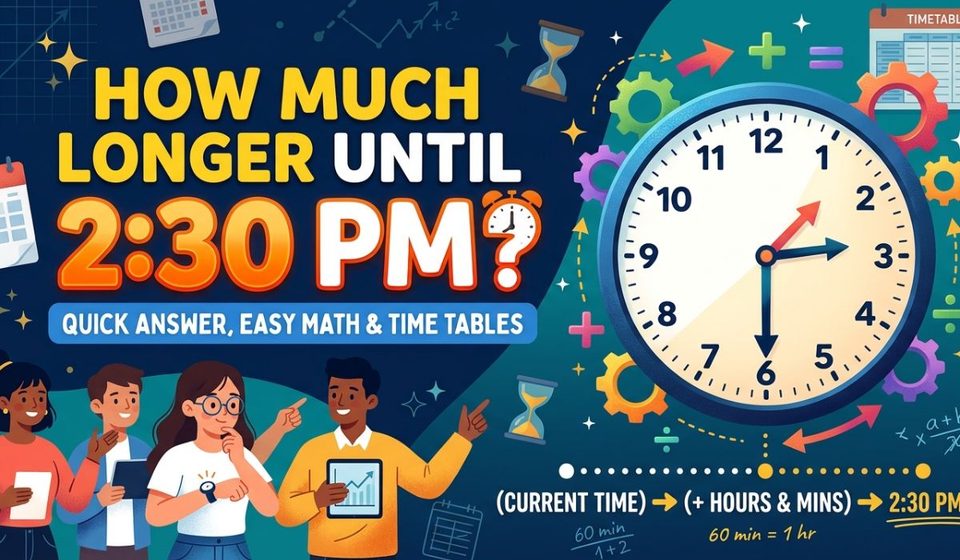

You glance at the clock and wonder how much longer until 2:30 PM. Maybe a meeting starts then, a bus leaves, or the school bell rings. Whatever the reason, you want a number, and you want it fast.
This guide gives you that number in a few seconds, then shows you how to work it out yourself from any starting time. You will find tables, step-by-step methods, and examples you can copy for your own day.
Quick Answer: How Much Longer Until 2:30 PM?
The wait until 2:30 PM equals 2:30 PM minus the current time. If it is 1:30 PM right now, you have exactly 1 hour left. If it is 2:00 PM, you have 30 minutes left.
Here is the shortcut that works every time. Count up to the next full hour, then add the remaining minutes. From 1:50 PM, that is 10 minutes to reach 2:00 PM plus 30 more, so the answer is 40 minutes.
Remember that your clock is the only live source here. This page cannot see the time on your device, so use the tables and methods below with whatever your clock shows right now.
Fastest Way to Check the Time Left
The quickest option is to say your current time out loud, then subtract it from 2:30. Most people can do this in their head once they have practiced a few times. A phone timer set to 2:30 PM is the other easy route, since it counts down for you.
Time Left Until 2:30 PM From Common Starting Times
This first table covers the most common situations. Find your current time in the left column and read the wait on the right.
| Current Time | Time Left Until 2:30 PM | Total Minutes |
| 8:30 AM | 6 hours | 360 |
| 9:30 AM | 5 hours | 300 |
| 10:30 AM | 4 hours | 240 |
| 11:30 AM | 3 hours | 180 |
| 12:00 PM | 2 hours 30 minutes | 150 |
| 12:30 PM | 2 hours | 120 |
| 1:00 PM | 1 hour 30 minutes | 90 |
| 1:30 PM | 1 hour | 60 |
| 2:00 PM | 30 minutes | 30 |
| 2:15 PM | 15 minutes | 15 |
| 2:25 PM | 5 minutes | 5 |
Reading the Table Quickly
Look at the minutes first. If your current time ends in :30, the answer is always a clean number of hours. That is the easiest case, because both times share the same minute value.
How to Calculate the Time Until 2:30 PM
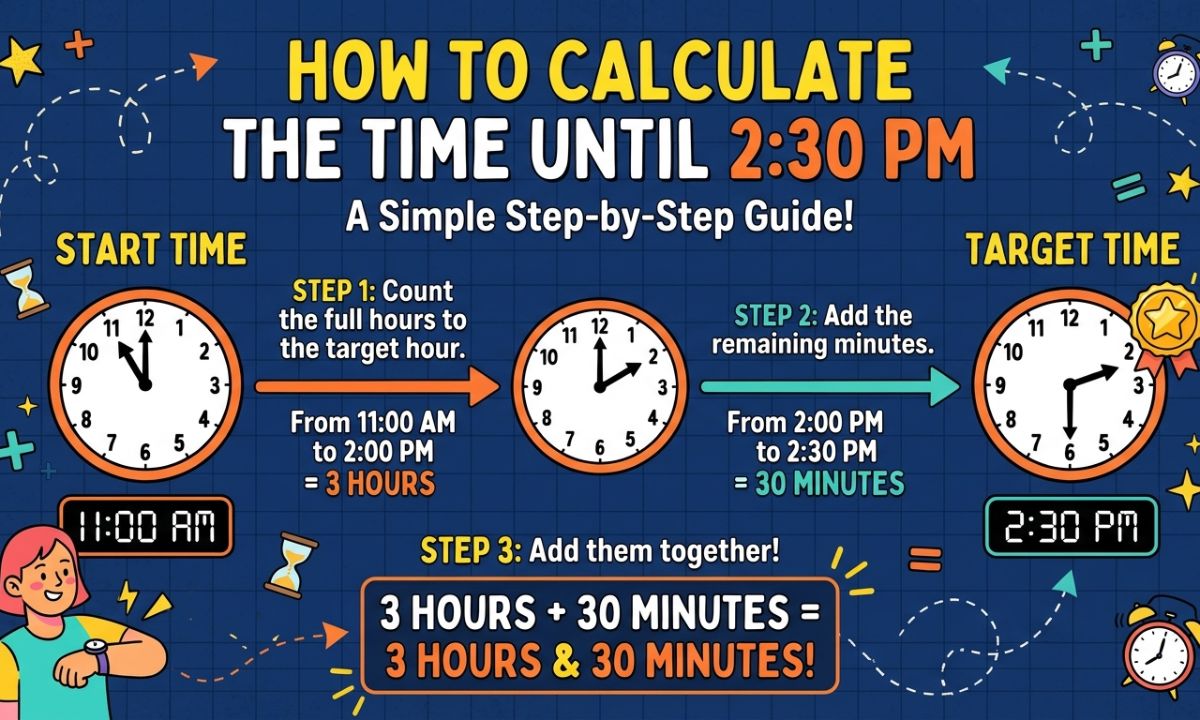
You do not need a calculator for this. A few simple steps will get you the right answer from any starting point, and the method never changes.
Step 1: Write Both Times Clearly
Put your current time and the target time side by side. Your target is 2:30 PM, which a 24-hour clock writes as 14:30. If your current time is in the morning, keep the AM label so you do not mix things up.
Step 2: Subtract the Hours
Take the hour of 2:30 PM, which is 2, and subtract your current hour. Do this in 12-hour form only when both times are in the afternoon. For morning times, switch to the 24-hour version, so 14 minus your hour gives you the gap.
Step 3: Subtract the Minutes
Now compare the minutes. If your current minutes are lower than 30, subtract them from 30 directly. If they are higher, borrow one hour, add 60 minutes, then subtract.
Step 4: Combine the Result
Put the hours and minutes together to get your answer. For example, from 11:45 AM, the hours gap is 3 and the minutes gap needs a borrow. That leaves 2 hours and 45 minutes, which is the final wait.
The Borrowing Trick Explained With Examples
Borrowing trips up more people than any other part of this calculation. The idea is simple: when your minutes are too high to subtract from 30, you take one hour from the hours column and turn it into 60 minutes.
| Current Time | Hour Gap | Minute Gap | Borrow Needed? | Final Answer |
| 1:10 PM | 1 | 20 | No | 1 hour 20 minutes |
| 1:40 PM | 1 | negative 10 | Yes | 50 minutes |
| 12:50 PM | 2 | negative 20 | Yes | 1 hour 40 minutes |
| 10:15 AM | 4 | 15 | No | 4 hours 15 minutes |
| 11:55 AM | 3 | negative 25 | Yes | 2 hours 35 minutes |
A Worked Example
Say it is 12:50 PM. The hour gap looks like 2, and the minute gap is 30 minus 50, which is negative 20. Borrow one hour, so 1 hour remains and the minutes become 60 minus 20, which is 40. The answer is 1 hour 40 minutes.
Converting the Wait Into Minutes and Seconds
Sometimes hours and minutes are not enough. If you are timing a cooking step, a medication reminder or a countdown, you may need the exact number of minutes or even seconds.
| Time Left | In Minutes | In Seconds |
| 5 minutes | 5 | 300 |
| 15 minutes | 15 | 900 |
| 30 minutes | 30 | 1,800 |
| 45 minutes | 45 | 2,700 |
| 1 hour | 60 | 3,600 |
| 2 hours | 120 | 7,200 |
| 3 hours 30 minutes | 210 | 12,600 |
The Simple Conversion Formula
To get total minutes, multiply the hours by 60 and add the leftover minutes. To get seconds, multiply that result by 60. So 1 hour 40 minutes becomes 100 minutes, and that equals 6,000 seconds.
How to Read 2:30 PM in Different Formats
Different apps and countries write the same moment in different ways. Knowing the common versions saves you from setting the wrong alarm.
- 2:30 PM: This is the standard 12-hour format used in the United States, Canada, Australia and the Philippines.
- 14:30: This is the 24-hour format common in Europe, Asia and military or hospital settings.
- Half past two: This is the spoken form used in everyday British and Commonwealth English.
- Two thirty: This is the short spoken form most people use in casual conversation.
Time Zones and Your 2:30 PM
If you are joining an online call, the 2:30 PM in the invite might not be your local 2:30 PM. Always confirm which zone the organizer means before you count down.
| If It Is 2:30 PM In | Time In UTC | Same Moment In London | Same Moment In New York |
| New York (EST) | 19:30 | 7:30 PM | 2:30 PM |
| Los Angeles (PST) | 22:30 | 10:30 PM | 5:30 PM |
| London (GMT) | 14:30 | 2:30 PM | 9:30 AM |
| Dubai (GST) | 10:30 | 10:30 AM | 5:30 AM |
| Karachi (PKT) | 09:30 | 9:30 AM | 4:30 AM |
| Sydney (AEDT) | 03:30 | 3:30 AM | 10:30 PM prior day |
Daylight saving changes shift some of these gaps by an hour at certain times of the year. When a deadline matters, check the current offset for the cities involved.
Practical Scenarios Where This Calculation Helps
Real life gives this question plenty of reasons to come up. Here are the situations people run into most often.
- Work meetings: A 2:30 PM call needs prep time, so knowing the gap helps you plan the last hour.
- School pickups: Many schools release students around this time, and parents time their commute to match.
- Appointments: Doctor, dentist and salon visits often land in the early afternoon, so a clear countdown prevents rushing.
- Travel connections: Buses, trains and flights leave on tight schedules, and a few minutes can decide whether you board.
- Deadlines: Some submissions close at 2:30 PM, and you want to know exactly how long you have left to finish.
Common Mistakes When Calculating Time Until 2:30 PM
Small errors cause big headaches with time math. Watch out for these frequent slips.
Mixing Up AM and PM
This is the biggest culprit. A person at 11:00 AM may subtract as if both times were in the afternoon and end up off by 12 hours. Always confirm that both times share the same half of the day.
Forgetting to Borrow an Hour
When the current minutes are above 30, people often subtract the smaller number from the larger one. That gives the wrong direction and a wrong answer. Remember that 1:40 PM is already past the half hour mark, so the wait is 50 minutes, not 10.
Treating Minutes Like Decimals
Time runs on a base of 60, not 100. Writing 1 hour 40 minutes as 1.40 hours is a common error. The correct decimal is about 1.67 hours.
Ignoring Time Zone Differences
An invite sent from another city may carry that city’s clock. Counting down to your own 2:30 PM when the host means theirs leads to missed calls.
Why People Search for How Much Longer Until 2:30 PM
Searches like this usually come from a quick, practical need. People are not looking for theory. They want a live number they can act on.
Many users are checking before a scheduled event, such as a meeting or a lesson. Others are watching the clock at work and waiting for a break or the end of a shift. Students count down to the end of a class period, and parents track school release times.
Some searches come from people who just woke up or came back from a trip and lost track of time. A few come from voice assistants, where someone simply asks the question out loud and expects a spoken reply.
Related Time Calculations You Might Need
If you found this page useful, you may also run into neighboring questions. The same method works for all of them with only the target time changed.
- How long until 2:00 PM: The same steps apply, but the target minute is 0, so borrowing is needed whenever your minutes are above zero.
- How long until 3:00 PM: This is exactly 30 minutes after 2:30 PM, so just add 30 to any answer on this page.
- How long until 2:45 PM: This sits 15 minutes after 2:30 PM, which makes it an easy adjustment.
- How many minutes until the end of the day: Count to midnight, then convert the hours and minutes into one number.
- What time will it be in 90 minutes: Add 1 hour, then 30 minutes, and watch the AM and PM change near noon.
Conclusion
Working out how much longer until 2:30 PM comes down to one subtraction. Take 2:30 PM, remove your current time, and borrow an hour when the minutes do not line up. The tables above cover the most common cases, and the step-by-step method handles everything else.
Check the AM and PM label, confirm the time zone, and set an alarm if the moment matters. With those three habits, you will never be caught off guard by the clock again.
FAQs About How Much Longer Until 2:30 PM
How much longer until 2:30 PM if it is 1:45 PM now?
You have 45 minutes left. That is 15 minutes to reach 2:00 PM plus 30 more.
How many minutes are left until 2:30 PM at noon?
At 12:00 PM there are 150 minutes left, which equals 2 hours and 30 minutes.
What is 2:30 PM in 24-hour time?
It is written as 14:30. Add 12 to the hour for any PM time after noon.
Is 2:30 PM the same as half past two in the afternoon?
Yes. Half past two and 2:30 PM describe the same moment, and both fall 30 minutes after 2:00 PM.
How do I find the time left until 2:30 PM in another time zone?
Convert your current time to that zone first, then subtract it from 2:30 PM. Checking the UTC offset for both cities keeps the result accurate.

