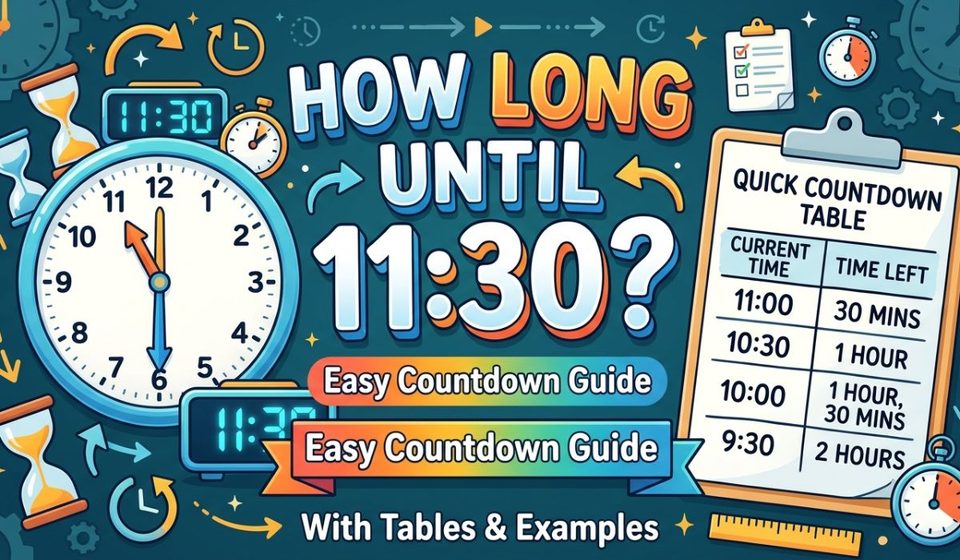

You glance at the clock and a quick question pops up: how long until 11:30? Maybe a meeting starts then. Maybe lunch is booked, a bus leaves, or an alarm is set. Whatever the reason, you want a number, and you want it fast.
This guide gives you that number in every common situation. You will find countdown tables for both 11:30 AM and 11:30 PM, a simple way to do the math in your head, and the mistakes that trip people up most often.
How Long Until 11:30? The Quick Answer
The wait until 11:30 equals 11:30 minus the current time. If it is 10:30 now, you have exactly one hour. If it is 11:00, you have 30 minutes. If it is 11:25, you have five minutes left.
The only catch is AM versus PM. When the time has already passed 11:30 AM, the next 11:30 is either tonight at 11:30 PM or tomorrow morning. Always check which one you mean before you count.
Here is a fast reference for the most common starting points.
| Current Time | Time Left Until 11:30 AM |
| 11:15 AM | 15 minutes |
| 11:00 AM | 30 minutes |
| 10:45 AM | 45 minutes |
| 10:30 AM | 1 hour |
| 10:00 AM | 1 hour 30 minutes |
| 9:00 AM | 2 hours 30 minutes |
| 8:00 AM | 3 hours 30 minutes |
| 6:00 AM | 5 hours 30 minutes |
Countdown Table for 11:30 AM
Morning countdowns are the most searched version of this question. People are usually waiting on a class, a call, a brunch, or a deadline before lunch.
The table below stretches back into the early hours, so you can see long waits too.
| Current Time | Hours and Minutes Left | Total Minutes |
| 12:00 AM (midnight) | 11 hours 30 minutes | 690 |
| 1:00 AM | 10 hours 30 minutes | 630 |
| 3:00 AM | 8 hours 30 minutes | 510 |
| 5:00 AM | 6 hours 30 minutes | 390 |
| 7:00 AM | 4 hours 30 minutes | 270 |
| 9:30 AM | 2 hours | 120 |
| 10:15 AM | 1 hour 15 minutes | 75 |
| 11:25 AM | 5 minutes | 5 |
Countdown Table for 11:30 PM
Late evening is the other big use case. Think of a late-night deadline, a movie that ends close to midnight, or a curfew.
Use this table when your target is 11:30 at night, which is 23:30 on a 24-hour clock.
| Current Time | Hours and Minutes Left | Total Minutes |
| 12:00 PM (noon) | 11 hours 30 minutes | 690 |
| 2:00 PM | 9 hours 30 minutes | 570 |
| 4:00 PM | 7 hours 30 minutes | 450 |
| 6:00 PM | 5 hours 30 minutes | 330 |
| 8:00 PM | 3 hours 30 minutes | 210 |
| 9:00 PM | 2 hours 30 minutes | 150 |
| 10:00 PM | 1 hour 30 minutes | 90 |
| 11:00 PM | 30 minutes | 30 |
Countdown When 11:30 Is Tomorrow
Sometimes you ask the question right after 11:30 has passed. In that case you are counting to the next one, and the wait is long.
| Current Time | Time Until Next 11:30 AM |
| 11:31 AM | 23 hours 59 minutes |
| 12:00 PM | 23 hours 30 minutes |
| 2:20 PM | 21 hours 10 minutes |
| 6:00 PM | 17 hours 30 minutes |
| 9:00 PM | 14 hours 30 minutes |
| 11:30 PM | 12 hours |
How to Calculate How Long Until 11:30
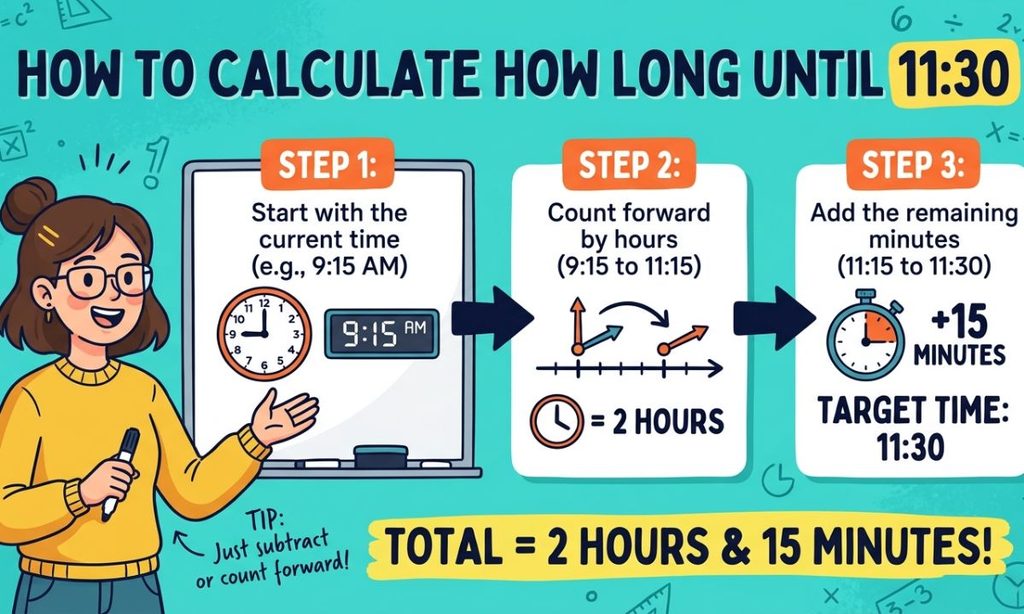
You do not need a calculator for this. Four short steps handle almost every case, and once you have done it a few times it becomes automatic.
Step 1: Decide Between AM and PM
Start by confirming your target. Is it 11:30 in the morning or 11:30 at night? Mixing these up is the biggest source of wrong answers, so settle it first.
Step 2: Convert Both Times to the Same Format
The cleanest method is the 24-hour clock. 11:30 AM stays 11:30, while 11:30 PM becomes 23:30. Convert the current time the same way, so 3:45 PM turns into 15:45.
Step 3: Subtract the Current Time
Subtract hours from hours and minutes from minutes. When the minutes of the current time are larger than 30, borrow one hour and add 60 to the 30. In other words, 11:30 becomes 10:90 for the purpose of the subtraction.
Step 4: Handle the Midnight Crossover
If the answer comes out negative, the target already passed today. Add 24 hours to your target and subtract again. This is how you get the wait for tomorrow’s 11:30.
Worked Examples
Seeing the steps in action makes them stick. Here are four common situations with the full math shown.
Example 1: It is 9:47 AM, counting to 11:30 AM. Write 11:30 as 10:90. Then 10:90 minus 9:47 gives 1 hour 43 minutes. Check it by adding: 9:47 plus 1:43 lands on 11:30.
Example 2: It is 8:12 PM, counting to 11:30 PM. Convert to 24-hour time, so 20:12 and 23:30. Then 23:30 minus 20:12 gives 3 hours 18 minutes.
Example 3: It is 2:20 PM, counting to 11:30 AM tomorrow. From 14:20 to midnight is 9 hours 40 minutes. Add the 11 hours 30 minutes from midnight to 11:30 AM, and the total is 21 hours 10 minutes.
Example 4: It is 11:05 AM, counting to 11:30 AM. The hours match, so just subtract the minutes. 30 minus 5 leaves 25 minutes.
Formula and Unit Conversions for 11:30
Some people want the answer in decimals or seconds, especially for timesheets, spreadsheets, and apps. These conversions cover the usual needs.
| Measure | Value for 11:30 AM | Value for 11:30 PM |
| Minutes since midnight | 690 | 1,410 |
| Decimal hours | 11.5 | 23.5 |
| Seconds since midnight | 41,400 | 84,600 |
| 24-hour format | 11:30 | 23:30 |
To turn a wait into decimal hours, divide the minutes by 60. A wait of 90 minutes is 1.5 hours, and 150 minutes is 2.5 hours.
| Wait in Minutes | Decimal Hours |
| 15 | 0.25 |
| 30 | 0.5 |
| 45 | 0.75 |
| 90 | 1.5 |
| 150 | 2.5 |
| 330 | 5.5 |
Real-World Situations Where 11:30 Matters
This particular time shows up everywhere because it sits right before the noon rush and right before midnight. Here are the places people most often count down to it.
- Late-morning meetings: Calls and appointments often start at 11:30 so they finish before lunch. Knowing the exact wait helps you decide whether to start a new task or wrap up an old one.
- School and exam schedules: Many classes and test sessions begin or end at 11:30 AM. Students check the countdown to plan breaks and last-minute revision.
- Brunch and lunch bookings: Restaurants commonly open for lunch service around this time. A quick calculation helps you leave on time and avoid a long queue.
- Travel departures: Buses, trains, and flights sometimes leave at 11:30. Counting down tells you how much buffer you have for getting to the station.
- Late-night deadlines: An 11:30 PM cutoff for submissions, orders, or shift end is common. The countdown keeps you honest about how much work still fits.
- Alarms and reminders: People set medication, bedtime, or wake-up alarms around 11:30. Checking the wait helps you plan sleep hours properly.
Time Zone Checks for 11:30
If the 11:30 you are chasing belongs to another city, convert it before you count. Otherwise your math is right but your answer is useless.
When New York is on standard time, 11:30 AM there equals 4:30 PM in London and 10:00 PM in India. Daylight saving changes can shift these gaps by an hour for a few weeks each year, so confirm with a world clock when the stakes are high.
Common Mistakes When Counting to 11:30
Most errors come from small slips, not hard math. Watch for these.
- Forgetting AM and PM: Counting to the wrong 11:30 can throw you off by twelve hours. Always label the target before you subtract.
- Treating minutes like decimals: 11:30 is not 11.30 hours. It is 11.5 hours, because 30 minutes is half of an hour.
- Skipping the borrow step: When the current minutes pass 30, people subtract the wrong way round. Remember that borrowing an hour gives you 90 minutes to work with.
- Ignoring midnight: A wait that crosses 12:00 AM needs the 24-hour adjustment. Without it, you get a negative number or a plain wrong one.
- Using a stale clock: Phone clocks update on their own, but wall clocks and ovens can drift. Check your reference time first.
- Mixing time zones: A meeting at 11:30 in another city is not 11:30 for you. Convert the zone, then count.
Why People Search “How Long Until 11:30”
The search is simple, but the reasons behind it vary. Understanding them helps explain why the question comes up so often.
Most people are mid-task and want certainty. Having an exact number, like 47 minutes, lets them plan a short errand, a workout, or a nap without the stress of watching the clock.
Others are anxious or excited about something coming up. A job interview, a result announcement, a flight, or a live event all work this way, and a countdown makes the waiting feel more manageable.
A smaller group searches because their clock is not nearby. They are on a phone, in a car, or at a desk with no wall clock, and a quick search is easier than doing the subtraction.
Finally, some searches come from habit in shared spaces, such as classrooms and offices, where several people want the same answer at once.
Related Calculations and Topics
If you found this useful, these nearby countdowns follow the same method. Swap the target time and use the same four steps.
- How long until 11:45: Fifteen minutes later than 11:30, so add 15 minutes to any wait you calculated here.
- How long until 11:15: Fifteen minutes earlier, which is handy when you want a buffer before a 11:30 start.
- How long until 12:00 PM: Exactly 30 minutes after 11:30, useful for planning lunch.
- How long until 11 PM: A half-hour shorter than the 11:30 PM wait, good for bedtime planning.
- Hours to minutes conversions: Multiply hours by 60 and add the leftover minutes to get a total you can compare quickly.
- 12-hour to 24-hour clock conversions: Add 12 to any PM hour, except 12 PM itself, to get military time.
Conclusion
Working out how long until 11:30 comes down to one subtraction and one question: AM or PM? Convert both times to a 24-hour format, borrow an hour when needed, and add 24 hours if the target already passed.
Keep the tables above handy for quick checks, and use the worked examples when you want to double-check your own math. With a little practice, you will answer the question at a glance.
FAQs About How Long Until 11:30
How many minutes are there until 11:30 if it is 11:00 now?
There are 30 minutes left. The hour is the same, so you only subtract the minutes.
How long until 11:30 AM if it is midnight?
It is 11 hours and 30 minutes, which is 690 minutes. Count the 12 hours from midnight to noon and take away the extra 30 minutes.
How long until 11:30 PM if it is 3:00 PM?
You have 8 hours and 30 minutes. Convert to 24-hour time and subtract 15:00 from 23:30.
Is 11:30 the same as 11.5 hours?
Yes, when you measure it as time since the start of a 12-hour block. Thirty minutes is half an hour, so 11:30 equals 11.5 hours.
What if 11:30 has already passed today?
Then you are counting to tomorrow’s 11:30, or to 11:30 PM tonight if it was the morning one. Add 24 hours to the target before you subtract.