


Wondering how long until 2:30? You can find the exact time left with a simple time calculation. It only takes a few steps to work out the difference between now and 2:30.
This guide explains how to calculate the time until 2:30 with easy examples. You will also learn a quick method to get the answer without confusion.
Quick Answer: How Long Until 2:30?
Subtract the current time from 2:30. That’s the whole trick.
- If it’s 1:30 PM right now, there’s 1 hour left until 2:30 PM.
- If it’s 2:00 PM, there are 30 minutes left.
- If it’s 12:00 PM (noon), you have 2 hours and 30 minutes.
- If it’s already past 2:30 PM, the next 2:30 is the following one, either 2:30 AM tonight or 2:30 PM tomorrow.
Look at your clock, find the closest row in the table below, and you’re done.
| If the time now is… | Time left until 2:30 PM | Total minutes |
| 12:00 PM | 2 hours 30 minutes | 150 |
| 12:30 PM | 2 hours | 120 |
| 1:00 PM | 1 hour 30 minutes | 90 |
| 1:15 PM | 1 hour 15 minutes | 75 |
| 1:30 PM | 1 hour | 60 |
| 1:45 PM | 45 minutes | 45 |
| 2:00 PM | 30 minutes | 30 |
| 2:15 PM | 15 minutes | 15 |
| 2:25 PM | 5 minutes | 5 |
| 2:29 PM | 1 minute | 1 |
First, Which 2:30 Do You Mean?
This is where most people trip up. A clock shows 2:30 twice a day.
- 2:30 AM is the middle of the night, deep in the overnight hours.
- 2:30 PM is mid-afternoon, also written as 14:30 in 24-hour time.
If you’re checking the time at 9:00 AM, you almost certainly mean 2:30 PM. If you’re up at 11:45 PM, you probably mean 2:30 AM. Context usually settles it, but when you’re scheduling something with another person, say “2:30 in the afternoon” or “14:30” to avoid a mix-up.
Time Left Until 2:30 AM
Here’s the countdown for the overnight version:
| If the time now is… | Time left until 2:30 AM |
| 8:00 PM | 6 hours 30 minutes |
| 9:00 PM | 5 hours 30 minutes |
| 10:00 PM | 4 hours 30 minutes |
| 11:00 PM | 3 hours 30 minutes |
| 12:00 AM (midnight) | 2 hours 30 minutes |
| 1:00 AM | 1 hour 30 minutes |
| 2:00 AM | 30 minutes |
How to Calculate the Time Until 2:30
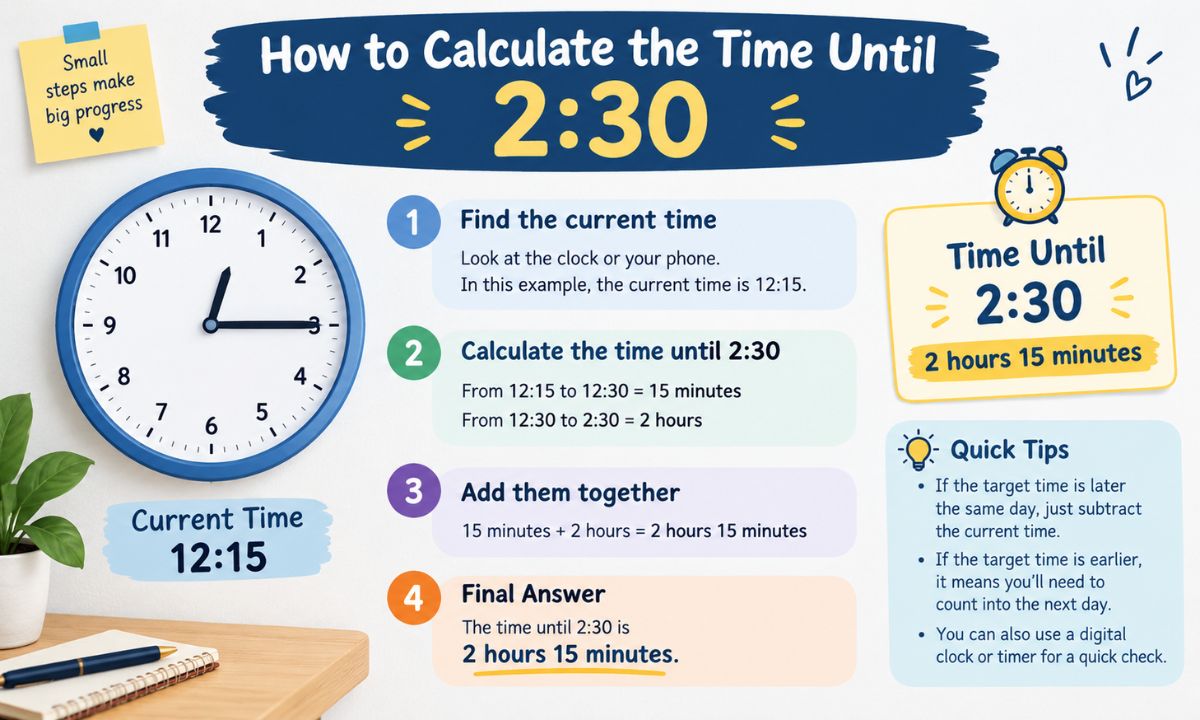
You don’t need an app. Here’s the method, broken into three steps.
Step 1: Pick Your Target
Decide if you want 2:30 AM or 2:30 PM. If it’s a 24-hour clock, the target is 02:30 or 14:30.
Step 2: Count to the Next Full Hour
From your current time, count up to the next hour mark. If it’s 11:20, that’s 40 minutes to reach 12:00.
Step 3: Add the Remaining Hours and Minutes
From 12:00 to 2:30 is 2 hours and 30 minutes. So from 11:20 to 2:30 PM:
40 minutes + 2 hours 30 minutes = 3 hours 10 minutes.
That’s it. Reach the hour, then add what’s left.
The Subtraction Method (Same Result)
If you prefer straight math, convert both times to minutes after midnight.
- 2:30 PM = 14:30 = (14 × 60) + 30 = 870 minutes
- Current time of 11:20 AM = (11 × 60) + 20 = 680 minutes
- 870 − 680 = 190 minutes, which is 3 hours 10 minutes
Same answer, different route. The minutes method is handy when the times are awkward, like 9:47 or 10:08.
Worked Examples With Real-Life Scenarios
Numbers make more sense when you attach them to something. Here are a few common situations.
| Scenario | Current Time | Target | Time Remaining |
| School pickup at 2:30 PM | 9:15 AM | 2:30 PM | 5 hours 15 minutes |
| Doctor appointment | 11:50 AM | 2:30 PM | 2 hours 40 minutes |
| Meeting starts | 1:42 PM | 2:30 PM | 48 minutes |
| Lunch break ends | 2:10 PM | 2:30 PM | 20 minutes |
| Early flight check-in | 11:15 PM | 2:30 AM | 3 hours 15 minutes |
| Night shift break | 12:40 AM | 2:30 AM | 1 hour 50 minutes |
Example 1: The Afternoon Meeting
It’s 10:35 AM and your call is at 2:30 PM. From 10:35 to 11:00 is 25 minutes. From 11:00 to 2:30 is 3 hours 30 minutes. Total: 3 hours 55 minutes.
Example 2: The Late-Night Alarm
It’s 11:50 PM and you need to be up at 2:30 AM. From 11:50 to midnight is 10 minutes. Midnight to 2:30 is 2 hours 30 minutes. Total: 2 hours 40 minutes of sleep, tops. Not great, but now you know.
Example 3: The Day-Crossing Countdown
It’s 4:00 PM and you want to know how long until the next 2:30 PM. You’ve missed today’s, so tomorrow’s is the target. From 4:00 PM to 4:00 PM tomorrow is 24 hours. Subtract 1 hour 30 minutes. You get 22 hours 30 minutes.
Converting 2:30 Into Other Formats
Sometimes you need 2:30 in a different shape for a spreadsheet, a timer, or a schedule app. Here are the handy conversions.
| Format | 2:30 AM | 2:30 PM |
| 12-hour clock | 2:30 AM | 2:30 PM |
| 24-hour (military) time | 02:30 | 14:30 |
| Decimal hours | 2.5 | 14.5 |
| Minutes since midnight | 150 | 870 |
| Seconds since midnight | 9,000 | 52,200 |
Quick tip: the half hour is always 0.5 in decimal form. That’s why 2:30 becomes 2.5 and 14:30 becomes 14.5. Spreadsheets and payroll tools often want decimals, so this one comes up more than you’d expect.
Common Mistakes and Misconceptions
Time math looks easy until it isn’t. These are the slip-ups that catch people most often.
Mixing Up AM and PM
This is the big one. Counting from 10:00 AM to 2:30 AM gives a very different (and very long) result than counting to 2:30 PM. Always confirm which half of the day you mean.
Treating 60 Minutes Like 100
Time isn’t decimal. If it’s 1:45 and you subtract from 2:30, you don’t get 0.85. You get 45 minutes. The hour has 60 minutes, so borrow 60 when you need to.
For example, 2:30 minus 1:45:
- You can’t subtract 45 from 30 directly.
- Borrow an hour: 2:30 becomes 1:90.
- Now 90 − 45 = 45 minutes, and 1 − 1 = 0 hours.
- Answer: 0 hours 45 minutes.
Forgetting the Day Rollover
Once the clock passes 2:30, the “time until 2:30” flips to the next day. Don’t return a negative number. Add 24 hours to your target and subtract again.
Ignoring Daylight Saving Changes
On the night clocks shift, the stretch between, say, midnight and 2:30 AM may be an hour longer or shorter. If you’re counting down across that night, double-check with a device that adjusts automatically.
Rounding Too Early
If you’re at 1:58 and you round to “about 2:00,” you’ll be off by two minutes. For a train or a call, that matters. Keep the exact minute.
Why People Search “How Long Until 2:30”
It’s a bigger query than it looks. People type it into search bars for a lot of reasons, and the intent is almost always practical and immediate.
- Appointments and meetings. A 2:30 slot is one of the most common times for a call, a dentist visit, or a parent-teacher meeting.
- School and daycare. Many schools let out in the early-to-mid afternoon, and parents want a quick countdown before pickup.
- Work shifts and breaks. Shift changes and break windows often land around 2:30.
- Live events and releases. Streams, sales, game drops, and webinars sometimes start on the half hour.
- Sleep and overnight schedules. Night owls, shift workers, and new parents check how long until 2:30 AM all the time.
- Medication and reminders. Some people time reminders on a clean half-hour schedule.
- Voice assistants. People ask their phone out loud, and the question gets typed or spoken as a short phrase.
The common thread is simple. Someone wants a number, and they want it now.
Related Time Calculations
If this topic is useful to you, these nearby questions come up just as often. Each follows the exact same method.
| Question | How to Work It Out |
| How long until 2:00? | Subtract the current time from 2:00. Half an hour less than the 2:30 answer. |
| How long until 3:00? | Add 30 minutes to your 2:30 answer. |
| How long until 2:45? | Add 15 minutes to your 2:30 answer. |
| How many hours until 2:30 tomorrow? | Count to midnight, then add 14 hours 30 minutes for tomorrow’s 2:30 PM. |
| How long ago was 2:30? | Subtract 2:30 from the current time instead. |
| What time is 2:30 in 24-hour format? | 02:30 for AM, 14:30 for PM. |
A Handy Shortcut: The Half-Hour Anchor
Because 2:30 sits right on a half hour, you can anchor your thinking to the closest half hour mark. If it’s 1:50, you’re 10 minutes shy of 2:00, and 2:30 is another 30 minutes past that. That’s 40 minutes. Splitting a long gap into “get to the next anchor, then finish” keeps the mental math light.
Using Your Phone or Computer
If you’d rather not count at all:
- Ask your voice assistant, “How long until 2:30?”
- Set a countdown timer for the number of minutes you calculated.
- Create a calendar event at 2:30 with a 15-minute reminder.
- Use a world clock if the 2:30 is in a different time zone, since your local countdown will be different from theirs.
The time zone point is worth repeating. A 2:30 PM meeting in New York is not 2:30 PM in Karachi or London. Always confirm the zone before you start counting.
Quick Reference Cheat Sheet
Keep this near your desk.
| Minutes Before 2:30 | The Clock Reads |
| 5 minutes | 2:25 |
| 10 minutes | 2:20 |
| 15 minutes | 2:15 |
| 30 minutes | 2:00 |
| 45 minutes | 1:45 |
| 60 minutes | 1:30 |
| 90 minutes | 1:00 |
| 120 minutes | 12:30 |
| 150 minutes | 12:00 |
Conclusion
Working out how long until 2:30 comes down to one move: subtract the current time from 2:30, and borrow 60 minutes when the minutes don’t line up. Pick the right 2:30, AM or PM, count to the next full hour, then add what’s left.
Use the charts above when you’re in a hurry, and the step-by-step method when you want to understand why the answer is what it is. Once you’ve done it a few times, you’ll be doing it in your head without thinking.
Frequently Asked Questions
How long until 2:30 PM if it’s 12:00 noon?
It’s 2 hours and 30 minutes, or 150 minutes. Noon to 2:00 PM is two hours, and then you add the extra half hour.
How many minutes until 2:30 if it’s 2:00?
There are 30 minutes left. That’s the simplest case since you’re already on the hour right before the half-hour mark.
How long until 2:30 AM if it’s midnight?
2 hours and 30 minutes. Midnight to 2:30 AM is exactly 150 minutes, the same gap as noon to 2:30 PM.
What if it’s already past 2:30?
The countdown moves to the next 2:30. If it’s 3:00 PM, the next 2:30 AM is 11 hours 30 minutes away, and the next 2:30 PM is 23 hours 30 minutes away.
How do I write 2:30 PM in 24-hour time?
It’s 14:30. Add 12 to the hour for any PM time after noon, and keep the minutes the same.


[…] how long until 2:20? You can quickly find the time left by comparing the current time with 2:20. A simple time […]